
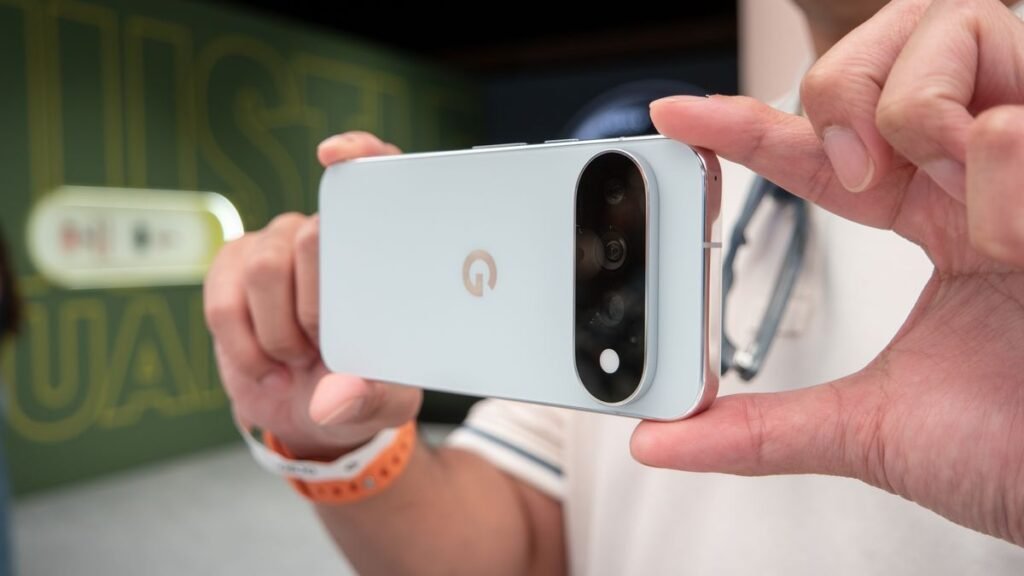
The Pixel 11 Pro adds three things the base Pixel 11 doesn’t have: a sharper display, a stronger camera system with real zoom range, and a few Pro-only extras like HiLight. Both phones run on the same Tensor G6 chip, so you’re not paying $200 more for speed. You’re paying for what the screen and camera can do. Here’s exactly what that extra money buys, based on going hands-on with both phones side by side.
Setup: Same Chip, Different Price Tag
I went into this comparison expecting the usual story; Pro model, better everything, pay up. That’s not quite what happened. The base Pixel 11 starts at $899, and the Pixel 11 Pro starts at $1,099. Same $200 gap Google’s run for a couple of generations now. But when I actually lined the spec sheets up, the Pro isn’t a better phone across the board. It’s a phone that upgrades two things hard; display and camera, and leaves almost everything else alone.
Both phones run Google’s Tensor G6 chip, both get seven years of software updates, both run Android 17 out of the box, and both are rated IP68 for water and dust resistance. If you’re buying a Pixel for how it feels to use day to day; app speed, Gemini features, general responsiveness. You’re getting the identical experience whether you spend $899 or $1,099.
So the real question isn’t “is the Pro better.” It’s “do you actually use the two things it’s better at?”
First Surprise: The Screen Difference Is Bigger Than the Spec Sheet Suggests
I expected the display upgrade to be one of those “you’d never notice unless you had them side by side” things. I was wrong.
The base Pixel 11 runs a 6.3-inch Actua OLED panel at 1080 x 2424 resolution, with a 60-120Hz refresh range and brightness up to 3,000 nits.
The Pixel 11 Pro steps up to a Super Actua LTPO OLED panel at 1280 x 2856, with a refresh rate that scales all the way down to to 1Hz and brightness up to 3,600 nits.
On paper, that’s a sharper screen and a smarter one; the Pro’s display can drop its refresh rate low when you’re just reading or looking at a static screen, which saves battery, and ramp back up instantly when you scroll or watch video. When I put both phones outside on a bright afternoon streaming the same video, the Pro’s extra brightness noticeably held up better against direct sun. Indoors, side by side, the difference is smaller, but it’s there in fine text and gradient colors.
If you spend a lot of time streaming video or reading outdoors, this is the upgrade that’ll actually matter to you every single day. If your phone mostly lives in your pocket or on a desk, you’ll probably forget the base model’s screen isn’t the “Super” one within a week.
Test: Where the Pro Actually Pulls Ahead — the Camera
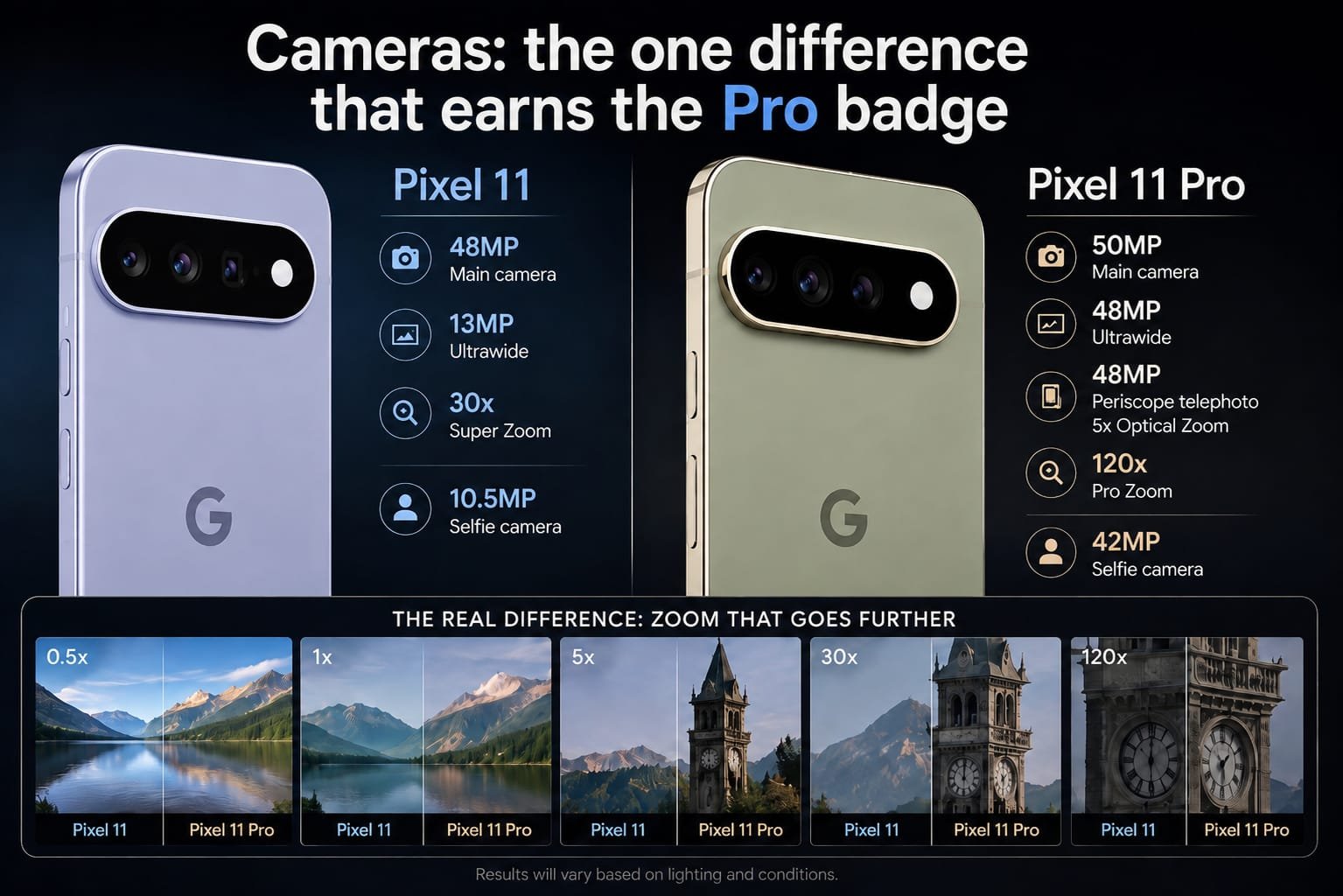
This is where the $200 gap earns its keep. The base Pixel 11 uses a solid dual-camera setup built for everyday shots; good in daylight, capable in low light, nothing flashy. The Pixel 11 Pro adds a 48MP ultrawide and a 5x periscope telephoto lens, pushing zoom range up to 120x with Pro Zoom, plus a larger main sensor for low-light shots.
I tested zoom range specifically, since that’s usually where budget-vs-Pro comparisons fall apart the fastest. Shooting the same subject from the same spot, the base Pixel 11 started losing real detail past about 5x zoom; expected, since it’s leaning on digital cropping past that point. The Pro’s periscope lens held up cleanly well past 20x, and even the far end of its zoom range produced usable, if soft, shots I wouldn’t have gotten at all on the base phone.
Selfie camera is a real gap too; the base Pixel 11 uses a 10.5MP front camera, while the Pro jumps to 42MP with a noticeably wider field of view, which matters if you’re regularly cramming a group into frame.
If you shoot a lot of low-light photos, use zoom regularly, or care about close-up detail shots, this is the section of the spec sheet that justifies the price gap on its own.
if you want the full breakdown of what megapixels and sensor size actually mean for photo quality, our camera buying guide covers it in plain terms.
Doubt: Is HiLight and the Rest Actually Worth Anything?
Here’s where I started second-guessing the upgrade. Beyond the screen and camera, the Pro’s remaining extras are thinner than they first sound.
HiLight is the headline Pro-exclusive feature. A rear LED that lights up for notifications, favorite contacts, and certain Gemini-related effects, built into the Pro’s matte-finish back panel. I liked it more as a novelty than a daily-use feature. It’s genuinely useful for glancing at your phone face-down and knowing who’s calling by color, but it’s not something I’d pay extra for on its own.
The Pro also adds Wi-Fi 7 and UWB (ultra-wideband, used for precise device-finding and some smart home features), plus the option to configure up to 16GB of RAM and 1TB of storage; neither of which exists on the base Pixel 11 at any price. Worth noting: at the base 256GB configuration, RAM is actually the same 12GB on both phones. You only see the RAM bump if you go up to the Pro’s 512GB tier.
One thing working against the Pro: the base Pixel 11 actually has a slightly larger battery, at 4,985mAh versus 4,850mAh on the Pro. It’s a small gap, and the Pro’s more efficient LTPO display claws some of it back, but it’s a reminder that “Pro” doesn’t mean better in every single spec.
Verdict: Who Should Actually Spend the Extra $200
After going hands-on with both, here’s how I’d split the decision:
Get the base Pixel 11 if: your photography mostly happens in daylight, you rarely zoom past 5x, and you want the same Tensor G6 performance without the premium. At $899, it covers what most people actually do with their phone.
Get the Pixel 11 Pro if: you shoot a lot of low-light or long-zoom photos, spend real time streaming or reading on your phone outdoors, or want the option to configure up to 1TB of storage. The extra $200 goes almost entirely into the screen and camera; not the processor, not everyday speed.
Both phones are available now through Amazon, Best Buy, and directly through Verizon, T-Mobile, and AT&T. If you already read our Pixel 11 first-impressions piece, the base model’s Tensor G6 performance and Magic Capture experience carry over identically to the Pro. The Pro just adds a better lens and screen on top of that same foundation.
