
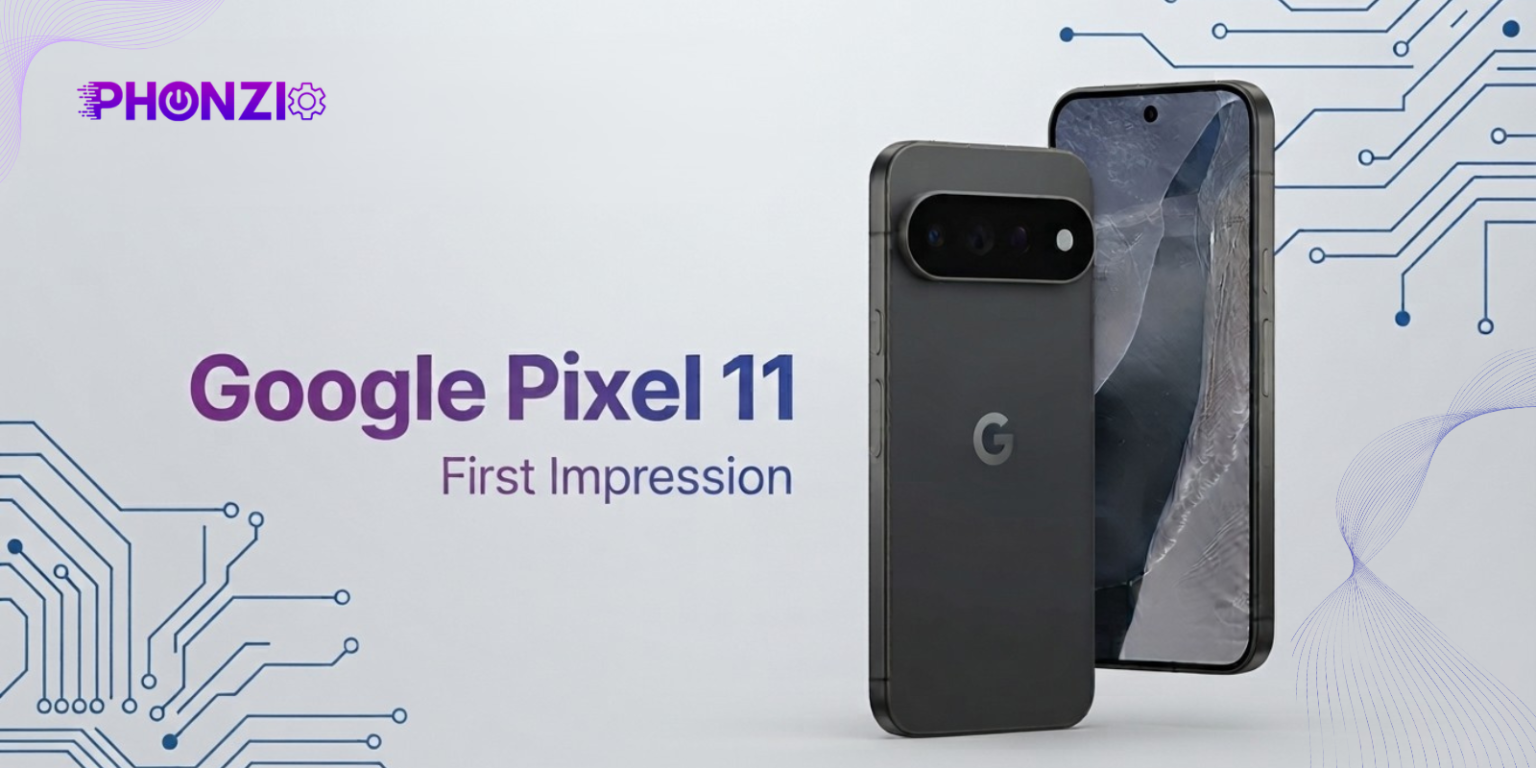
Today’s the day. As of August 20, 2026, the Pixel 11 is officially sitting on shelves at the Google Store and with retail partners across the country. After weeks of leaks and a launch event on August 12, Google’s newest flagship isn’t a rumor anymore. It’s real, it’s buyable, and I’ve spent my first hours with it figuring out what’s actually different this year.
This is my first impression, not my full review. I want to live with this phone a bit longer before I call a final verdict. But launch day is exactly the right moment to talk about what changed, especially the one upgrade nobody’s talking about enough: the chip.
The Real Star of This Launch Isn’t the Camera
Every year, Pixel launches lead with photos. This year, the more interesting story is happening somewhere you can’t even see it, inside the phone, with the new Tensor G6 chip.
Here’s why that matters. Past Tensor chips were known for one thing: falling behind. Samsung and Qualcomm’s chips almost always beat Google’s in raw speed and power, and Pixel owners just learned to live with it.
That’s part of why this year feels different.
The Tensor G6 uses brand-new processor cores from ARM, called C1-series cores, the same cores found in Samsung’s newest chip and MediaTek’s newest chip. For the first time in years, Google’s chip isn’t a generation behind. It’s sitting in the same room as the competition.
Google is also being specific about the gains. The company says the G6 brings 20% greater energy efficiency, 25% faster web browsing, and 15% faster app launch times compared to last year’s chip. Those aren’t huge, flashy numbers, but they’re the kind that actually change how a phone feels day to day, not just how it scores on a benchmark test.
The bigger story is AI. Google says the G6 can handle on-device AI tasks up to 3.5 times faster while using up to 3.5 times less battery than the previous generation. That’s the number that explains why Gemini, Magic Capture, and voice typing all feel quicker and smoother on this phone than they did last year. The chip isn’t just faster. It’s built specifically to make AI feel instant instead of something the phone has to think about.
Google also switched something under the hood that Pixel owners have complained about for years: the modem. Past Pixels used a Samsung modem, and a lot of people blamed it for weak signal and battery drain. The Pixel 11 switches to a MediaTek modem instead. It’s not a headline feature, but if it actually fixes years of connection complaints, it might end up mattering more than anything else Google announced.
Now for the honest part. This chip is still not trying to be a gaming powerhouse. The graphics side of the G6 remains its weak point, and Qualcomm’s top chip still leads there. If you’re someone who plays graphics-heavy games on your phone, this chip won’t change your mind. But if you use your phone the way most people actually do, checking notifications, taking photos, asking Gemini for help, typing messages, this is a chip built exactly around that.
What makes this even better for anyone shopping on a budget: the Tensor G6 isn’t locked behind the Pro price tag. It’s the exact same chip in the standard Pixel 11 and the $1,099 Pro. You’re not paying extra just to get better performance this year.
What Else Is New, Briefly
The chip is the headline, but a few other things changed too:
Camera upgrade — The base Pixel 11 gets a genuinely new 48MP main camera sensor, larger than what was in the Pixel 10, along with an f/1.7 aperture. It’s a real step up in image quality, not just a spec sheet change.
Magic Capture — Instead of trying to time your shot perfectly, you hold the shutter and the phone records a short clip in the background, then picks the sharpest, best-timed frame for you automatically.
Bigger base storage — Storage starts at 256GB this year, double what the Pixel 10 offered at launch. The old 128GB option is gone.
Slimmer design — The camera bar on the back is noticeably slimmer than last year’s, giving the phone a more compact feel in the hand.
New colors — The Pixel 11 comes in four shades: Obsidian, Frost, Pistachio, and Hibiscus. My personal favorite is Obsidian.
Quick Facts
- Price: $899 (256GB), $1,019 (512GB)
- Chip: Google Tensor G6
- RAM: 12GB
- Display: 6.3-inch OLED, up to 3,000 nits peak brightness
- Battery: 4,985mAh, 30W wired charging, 25W wireless charging
- Colors: Obsidian, Frost, Pistachio, Hibiscus
- Release date: Officially available now, as of August 20, 2026
For the full spec sheet, check out the page of Google Pixel 11 Specifications.
Where I Stand After Day One
Google didn’t just chase a flashier camera or a louder headline feature this year. The real change is under the surface, in a chip that finally stops apologizing for itself. Whether that’s enough to call this phone a true “flagship” moment is something I need more time to answer honestly.
My full review is coming once I’ve lived with this phone for more than a few hours. For now, if you’re deciding whether to walk into a store today, know this: the thing worth paying attention to isn’t what’s on the back of the phone. It’s what’s running the show inside it.
That’s all from me, at least for now. But if you’re interested in owning the new Google Pixel 11, make sure to check current availability and configure your device directly through the Google Store.
They have some great deals going while supplies last, so don’t wait too long to lock in your model and color.
