
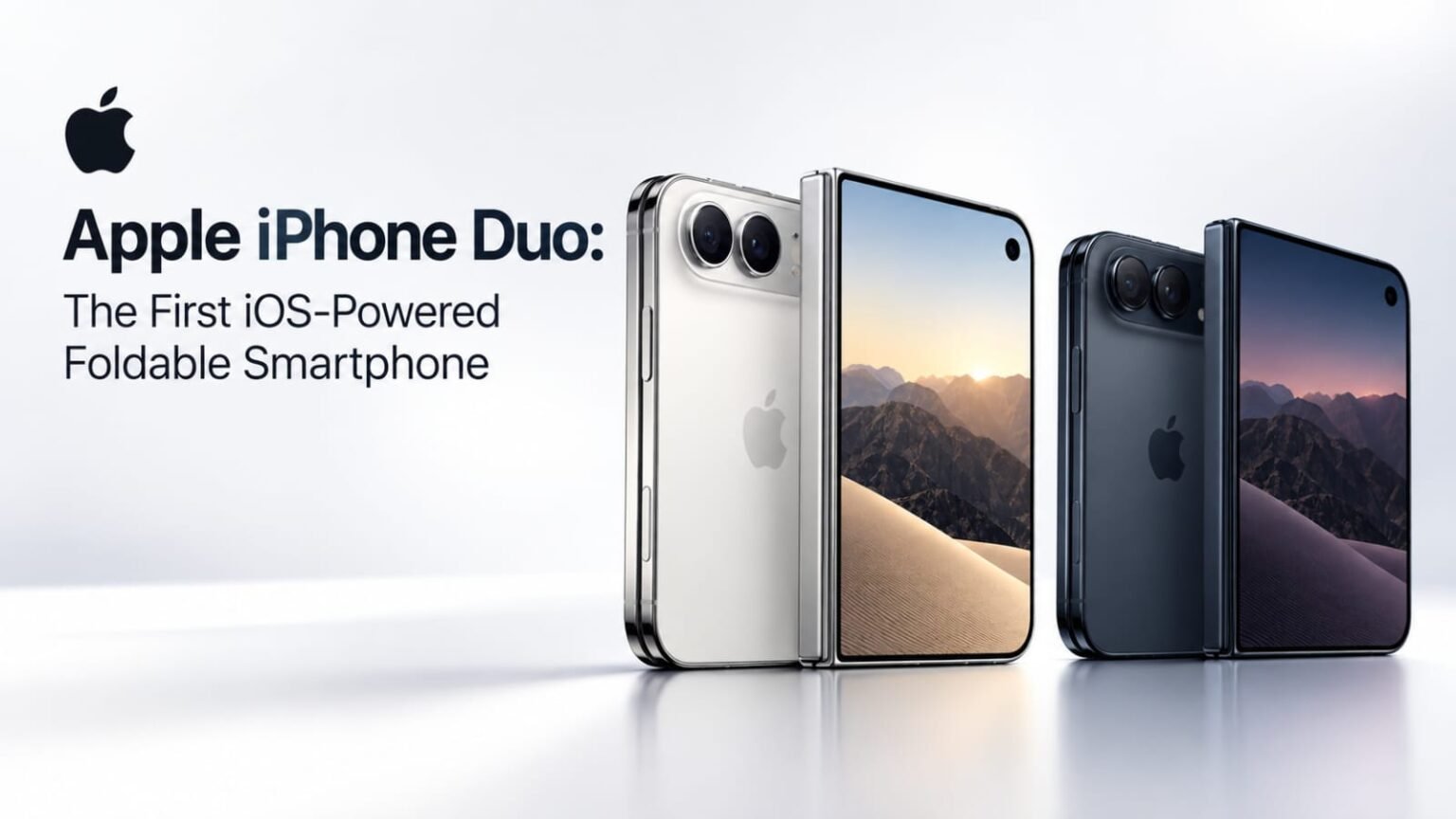
Apple’s first foldable phone is official. The iPhone Duo was unveiled on September 9, 2026, and it brings a 7.6-inch folding display, the A20 Pro chip, and a reworked version of iOS built specifically for a hinge. Pre-orders open October 16, and the phone ships October 23 starting at $1,999.
I’ve spent the last few years covering every foldable phone that’s landed in the US market, and I have a confession: I didn’t think Apple would take this long. Samsung shipped its first Galaxy Fold back in 2019. Google followed years later. Apple just now showed up to a party that’s been going for seven years. But after digging through everything Apple released about the Duo, I don’t think Apple was late by accident. I think they were waiting for the software to catch up to the hinge.
The real story isn’t the fold. It’s iOS.
Every other foldable on the market runs Android stretched across two screens. It works, but it always feels like a phone wearing a costume. The apps resize, the icons rearrange, and you can tell the operating system wasn’t born for this shape.
iPhone Duo is the first time I’ve seen an operating system built around a fold instead of bolted onto one. iOS 27 moves the lock screen controls and the home screen dock to the side of the display, which frees up vertical space instead of squeezing your apps into a taller, narrower box. When you open the phone flat, the home screen shows two pages side by side instead of one long scroll. Even the status bar changes shape, turning into a small circular element that sits in the corner instead of stretching across the top.
That’s a small detail, but it tells you Apple didn’t just make an iPhone that folds. They made software that knows it’s folding.
Titanium, magnets, and a screen built to hide its crease
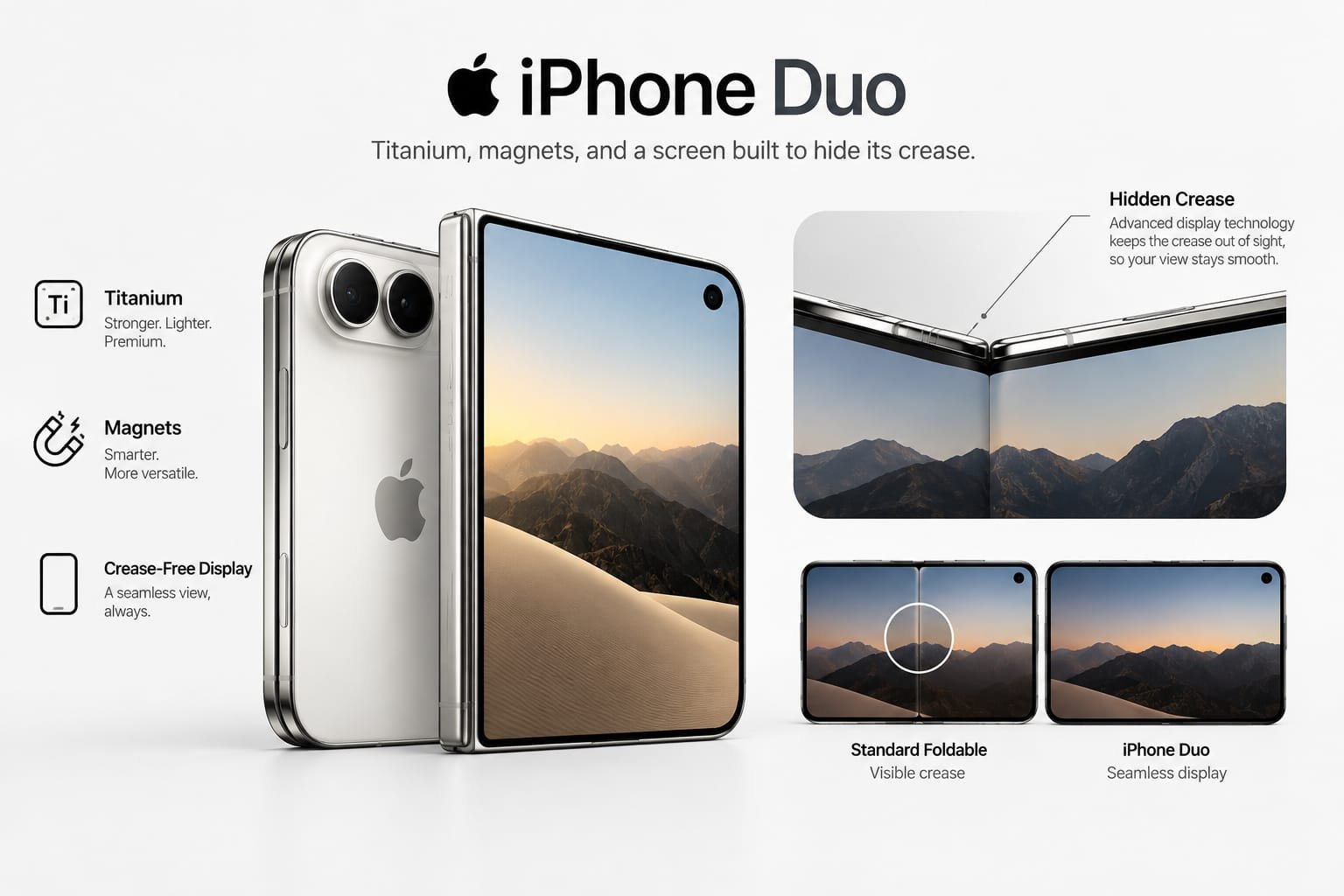
The frame is Grade 5 titanium, and Apple gave the hinge cover the same material. There’s Ceramic Shield on the back and an upgraded Ceramic Shield 2 on the front. The whole thing carries an IP68 rating, so it’s rated for dust and water like a normal iPhone, not a fragile science project.
The hinge itself has a magnet array built in, which is why it reportedly snaps shut with a satisfying click instead of just flopping closed. That’s the kind of detail that sounds minor until you’ve used a foldable with a loose hinge for a week and started to wonder if it’s slowly wearing out.
The bigger engineering story is the crease. Every foldable phone has to deal with a visible line where the screen bends, and it’s usually the first thing people notice when they pick one up. Apple used a custom nano-texture finish on the inner display along with optically clear adhesives designed to let the display layers glide as the phone opens and closes, which is supposed to cut down on stress at the fold point. I want to see this in person before I make any promises, but on paper, it’s a more thoughtful approach than gluing a screen protector over the problem.
The biggest iPhone screen ever made
When it’s open, the iPhone Duo has a 7.6-inch Super Retina XDR display, and Apple says that’s 50 percent larger than the iPhone 18 Pro Max screen. Closed, the outer display is 5.4 inches, which covers more than 90 percent of the screen area you’d get on a regular iPhone 18 Pro. Both displays hit 3,000 nits of peak brightness and support ProMotion, so you’re not giving up smoothness just because the phone folds.
For anyone who streams shows, reads a lot, or multitasks between apps, that’s a real upgrade over a standard iPhone screen, not just a bigger number on a spec sheet.
What iOS 27 actually lets you do with it
The screen size only matters if the software uses it well, and this is where Apple leaned in. Split View lets you run two apps side by side on the inner display, and you can save app pairs you use often so you’re not rebuilding the layout every time. The Dynamic Island now sits along the side of both screens and expands out to show alerts and Live Activities. You can prop the phone up in a tent shape and take FaceTime calls hands-free, or stand it up in StandBy mode for a bedside clock or photo display.
None of this is possible on a flat iPhone. That’s the argument Apple is making for why this phone is worth existing, and after reading through everything, it’s a more convincing argument than I expected going in.
The camera trade-off you need to know about
Here’s where I’ll be straight with you: iPhone Duo does not have a telephoto lens. You get a 48MP Fusion Main camera and a 48MP Fusion Ultra Wide camera, plus 2x optical-quality zoom cropped from the main sensor. Compare that to the iPhone 18 Pro Max, which has a dedicated telephoto camera with up to 8x optical-quality zoom, and the Duo is giving up real reach.
What you get instead are features that only make sense on a foldable. Duo Preview lets whoever you’re photographing see themselves on the outer display so they can check their own framing. Smart Take waits until everyone in the shot looks ready before it fires the shutter. Kid Cue plays little animations on the outer screen to get toddlers to actually look at the camera, which is a problem every parent with a phone has dealt with. If you’re the family photographer at every gathering, these features solve real problems that a telephoto lens never will.
The price, and what you’re actually paying for
iPhone Duo starts at $1,999 for 256GB, then climbs to $2,199 for 512GB, $2,599 for 1TB, and $3,199 for 2TB. It’s eSIM-only everywhere, so if you’re switching from an older phone with a physical SIM, you’ll need to plan around that with your carrier. Instead of Face ID, Apple built Touch ID into the side button, and you can also unlock the phone with your Apple Watch.
Battery life is rated up to 31 hours of video playback on the inner display, 44 hours on the outer display, and around 24 hours if you’re using both screens evenly throughout the day. Wired charging gets you to 50 percent in about 20 minutes, and wireless charging with MagSafe or Qi2 gets you there in about 30.
Two thousand dollars is a lot to ask, but it’s actually in line with where Samsung’s Galaxy Z Fold8 Ultra sits once you’re comparably configured. Apple isn’t undercutting the foldable market on price. They’re betting that the software experience is different enough to justify showing up at the same price point everyone else already charges.
My early take
I haven’t held this phone yet, and I’m not going to pretend I have. What I can tell you is that after five years of foldables that all run the same operating system stretched into a new shape, iPhone Duo is the first one where the software reads like it was actually designed for the hardware. That alone makes it the most interesting foldable launch since the original Galaxy Fold.
Whether it’s worth $1,999 over a Galaxy Z Fold8 Ultra comes down to how much you value the Apple ecosystem and how much that crease-reduction engineering actually holds up in daily use. I’ll have a real answer once a unit is in my hands. Until then, if you’re deciding whether to pre-order on October 16, keep your eyes on how these two phones compare spec for spec, because that’s where the real decision gets made.
