
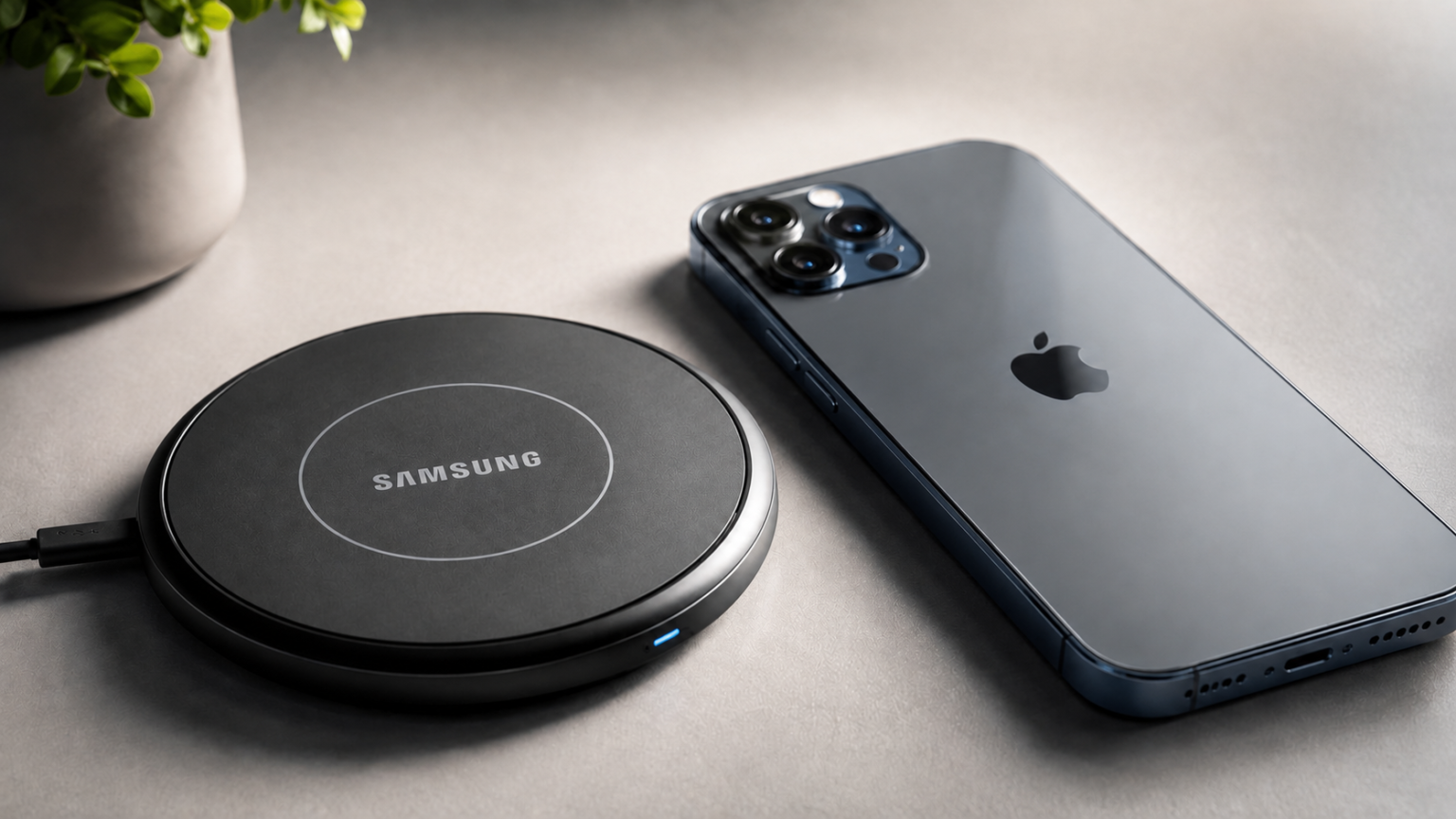
Yes, a Samsung wireless charger will charge an iPhone, as long as two things are true: the charger uses the Qi standard (nearly all Samsung pads do), and your iPhone is an iPhone 8 or later. It’ll work fine for overnight charging. It just won’t be fast, and there are a few gotchas worth knowing before you assume your specific pad will play nice with your specific phone.
I found this out by accident. My partner switched from an iPhone 13 to a Galaxy S24 last spring, which meant our nightstand suddenly had two wireless chargers on it: my old Samsung 15W pad and her new one. Before I went out and bought a third charger just for my iPhone, I figured I’d try the obvious thing first. I put the iPhone on the Samsung pad and waited.
It worked. It’s been working for over a year now. But “it works” isn’t the whole story. “Compatible” and “optimal” turn out to be two very different things.
Why This Works: Qi Isn’t a Samsung Thing or an Apple Thing
A lot of people assume wireless charging is brand-locked, the way a Lightning cable or a proprietary fast-charging plug might be. It isn’t. Qi (pronounced “chee”) is an industry standard maintained by the Wireless Power Consortium. Both Apple and Samsung build their wireless charging hardware around it. That’s why a charger with zero Apple branding on the box can still charge an iPhone. The phone doesn’t know or care who made the coil underneath the pad. It just needs the pad to speak Qi.
I’ve bounced my iPhone between three different Samsung pads over the past year: the one that shipped with an old Galaxy phone, a Samsung 15W stand (around $25-30 on Amazon), and a cheaper Samsung Duo pad a friend lent me. All three charged it without issue.
The one thing that did trip me up: an older Samsung charger from a past Galaxy generation turned out to be a proprietary fast-charging pad rather than a standard Qi one. It still charged the iPhone, just noticeably slower than expected, because it fell back to base Qi speed. So “it’s a Samsung charger” isn’t quite enough information. You want to confirm it’s Qi-certified, which is printed on the box or listed in the product specs wherever you’re buying it, whether that’s Amazon, Best Buy, or Samsung’s own site.
Where People Get Tripped Up: Speed
Here’s the part that actually matters if you care about charging time.
Samsung sells chargers rated at 15W. Apple’s own MagSafe charger, which runs about $39 at Apple or Best Buy, is rated up to 25W on newer iPhones under specific conditions. But an iPhone on a Samsung 15W pad isn’t pulling anywhere near 15W in my experience. It settles closer to the 7.5W ceiling that Apple has historically applied to standard, non-MagSafe Qi charging on iPhones.
I checked this with a basic USB power meter between the wall adapter and the charger, rather than trusting an app. The draw at the wall consistently topped out well under what the Samsung pad is rated for.
That’s not a Samsung-specific problem. It’s how the negotiation between phone and charger works. The wattage printed on a charger is the maximum it’s capable of delivering. It’s not a promise. The phone and the pad talk to each other and agree on a speed both support. For a non-MagSafe iPhone on a Qi pad, that ceiling has historically sat around 7.5W, regardless of whether the box says 10W or 15W.
If your charging feels slower than it should across the board, not just on a Samsung pad, here’s how to track down the real cause.
Practical takeaway: if you’re buying a Samsung charger specifically hoping it’ll fast-charge your iPhone the way it fast-charges a Galaxy phone, don’t. It’ll charge it fine overnight. It won’t be fast.
The MagSafe Question
This is the other place people get confused, because MagSafe gets talked about like it’s just “Apple’s version of wireless charging.” It’s not. It’s wireless charging plus a ring of magnets that snap the phone into perfect alignment with the coil.
Samsung pads don’t have that magnet ring, with one narrow exception: some newer “Qi2” chargers support magnetic alignment as part of an updated, brand-agnostic version of the Qi standard. It’s worth checking whether your Samsung charger is Qi2 or the older Qi 1.x/EPP.
Without magnets, alignment is on you. You have to actually watch where you set the phone down. I’ve had a couple of nights where I woke up to a nearly-dead phone because it had drifted an inch off-center overnight and stopped charging. That’s the real tradeoff. More than raw speed, a MagSafe charger physically can’t be misaligned. A plain Qi pad absolutely can.
If your Samsung charger happens to support Qi2, alignment gets a lot more forgiving. If it’s an older Qi pad, get in the habit of checking the placement, especially if you’re tossing the phone down in the dark.
Cases, Multi-Device Pads, and Other Real-World Snags
A few things I’ve run into that are worth knowing before you spend twenty minutes troubleshooting a “why isn’t this charging” problem, like I did:
Thick cases are the most common culprit. My case has a built-in kickstand with a small metal plate. It was enough to stop charging entirely until I removed it. Anything with a magnetic wallet attachment, a metal plate, or just extra-thick material is worth testing without the case first.
Multi-device pads (Duo/Trio-style) aren’t uniformly compatible across every slot. Samsung’s multi-charger stations are generally built to also support iPhones, but not every position on every model is guaranteed to work with every phone. Check the specific product page for your exact model rather than assuming.
The power adapter matters as much as the pad. A Qi charger plugged into a weak or damaged USB adapter will underperform no matter how capable the pad itself is. If charging seems inconsistent, swap adapters before you blame the charger.
Should You Bother With MagSafe Instead?
Honestly, it depends on what you’re optimizing for.
If your only goal is “phone charges overnight without me plugging in a cable,” a Samsung Qi pad you already own does that job completely fine. There’s no reason to spend $30-40 duplicating something you have. That’s exactly the situation I was in, and a year later I still haven’t bought a dedicated Apple charger.
If you want faster daytime top-ups, or you’re the kind of person who tosses their phone down without looking, the magnetic snap of MagSafe, or a Qi2-certified pad from any brand (Anker and Belkin both sell Qi2 pads in the $25-40 range at Amazon and Best Buy), solves a real annoyance and can charge meaningfully faster on supported iPhones.
| Samsung Qi Charger | MagSafe / Qi2 Charger | |
| Charges an iPhone | Yes, if Qi-certified | Yes |
| Needs precise placement | Yes | No — magnets self-align |
| Typical iPhone speed | ~7.5W, regardless of the pad’s rated max | Up to 25W on supported iPhones, under ideal conditions |
| Works with a case on | Usually, if the case isn’t thick or metal-lined | Usually — MagSafe cases improve alignment |
| Typical price (USD) | $15-30 | $25-40 (Qi2) / ~$39 (Apple MagSafe) |
| Good for casual/overnight charging | Yes | Yes |
Quick Answers to the Questions I Get Asked Most
Will my Samsung charger damage my iPhone? Not if it’s a genuine, Qi-certified pad used as intended. I’d steer away from unbranded, no-name chargers off marketplace sites regardless of what phone you’re charging. That’s a certification issue, not a Samsung-vs-Apple issue. (If you’re chasing down charging speed problems more broadly, this breakdown of the 10 most common causes is worth a look.)
Can I switch the same pad between my Galaxy phone and my iPhone? Yes, that’s the whole point of Qi being a shared standard. I do this daily.
My phone starts and stops charging on the Samsung pad. What’s going on? Nine times out of ten it’s placement (drifted off-center) or a case interfering. Pull the case off and center the phone directly over the coil before assuming the charger is broken.
Is it worth buying a Samsung charger specifically for my iPhone? Not really. If you’re buying new, there’s no cost advantage to a Samsung-branded Qi charger over any other certified Qi pad from Amazon or Best Buy, and you won’t get MagSafe-speed charging either way unless it’s specifically Qi2. Buy based on Qi/Qi2 certification, not the logo on the box.
